 Since last week's post on Venice proved so popular, I thought I would leave you with some more images from the Australian of that beautiful city this weekend.
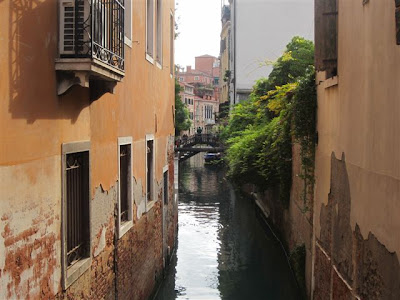


 Since last week's post on Venice proved so popular, I thought I would leave you with some more images from the Australian of that beautiful city this weekend.
 Just some images today of the charming old city of Dubrovnik, Croatia from the Australian.


 The Palazzo Santa Sofia, commonly known as the Ca' d'Oro or golden house, is a 15th century palazzo along the Grand Canal in Venice. You probably recognize it from myriad postcards or the backdrop to movies, I know I do!
 The building is known as the golden house because its exterior used to be decorated with gilt and polychrome but now is natural stone; Old habits die hard I suppose!
  Built for the Contarini family by sculptor/ architect Giovanni Bon and his son, Bartolomeo Bon, in gothic style, it was a more decorative version of the style prefered by the Venetians which the Bon's made famous throughout Venice.
  One arrives off the Grand Canal to the boat launch behind a screened loggia.
 Which gives entry to the courtyard.
 The loggias surrounding the courtyard have gorgeous inlaid marble floors and byzantine capitals topping the columns.
 How many different types of marble can you count here?
 The loggias upstairs off the main compartments offer breathtaking views of the Grand Canal.
 Since 1922 the house has been owned by the state and operates as a museum.
 In the collection is this bronze winged lion. The winged lion is representative of St. Mark the Evangelist who is the patron saint of the city and stands as the symbol of the city.
 Photos courtesy of the Australian.
 Located along the Grand Canal in Venice is the Palazzo Cavalli Franchetti. Now housing the Venetian Institute of science, letters and arts, the palace started life in 1565 with many renovations since.
  Like many of the palaces facing the Grand Canal, the main rooms are on the upper floors facing the canal providing beautiful views, seen in the room above. Notice the Venetian glass chandelier.
 While the Australian (who was kind enough to share these pictures) was in Venice, the Bienalli was taking place and the palace housed the glass exhibition, seen in part in the stairway above.

 The palace has a rare side garden facing the canal which during the Bienalli housed a strange house called the Narrow House.
 Designed by Austrian artist Erwin Wurm as a reconstruction of his childhood house but squished to scale to only 1 meter wide to reflect the crowded conditions in Venice and the tricks our mind plays on our memory.
  And I'm showing this because it's just amazing the detail that Wurm went to, but I promise you it's the only toilet you will ever see on ArchitectDesign!
 Yesterday I showed you Venice from the air via the bell tower of San Giorgio Maggiore. Today we'll explore the interior of the church.
 As I said yesterday, the building was designed by noted architect Andrea Palladio in 1565 after he had worked on the adjacent monastery for the Benedictine Monks who run the church.
 The church was finished in 1610, 30 years after Palladio's death.
  The original bell tower from 1467 fell down in 1774 and was rebuilt 20 years later in Neoclassical style to better suit Palladio's efforts.
 At the crux of the center nave, where the tower is located, is a strange smoke machine installed for the Biennale.
 One sees many famous images of Venice but only the brave witness it from the air.
 My Australian climbed to the top of San Giorgio to capture the city spread far below.
 Having never been there, the thing that strikes me immediately is the immensity of the city! I always assumed it was small but here it is, a bustling seaport spread out through so much water. No wonder it is a popular cruise destination!
 Below is the roof of San Giorgio. More on what that silver tube is in tomorrow's post!

 Now that explains the strange piping we saw on the roof
  The interior is crisp, white and clean -the type of classicism I love best.
 Located behind the apse alter screen, seen above, is a beautiful choir stall.
 Designed by Palladio, the stalls were built between 1580 and 1589.
 And I couldn't let you go without a close up of the gorgeous marble floors!


 You recognize St. Mark's square above, across the water, with the familiar Doge's Palace.
 I had no idea the waterways were so large nor so busy!