 One of my favorite companies to visit at Highpoint Market is Theodore Alexander. Their commitment to high quality wood furniture, both new and reproduction, is always astounding.
 While their reproductions are what the company is most well known for, such as Althorp, they also produce a line designed by the Keno Brothers, of Antiques Roadshow fame. The brothers' line is inspired by the lines of mid-century modern but incorporates the high quality wood detailing that the company is so well known for.
 I think my favorite pieces of all though are these miniature chairs and reproductions which measure in at a mere 11" high. How great would these look lined up on a bookshelf? I suppose they bring out the child in us all!


 Congratulations to Andrew Zega and Bernd Dams from


 My Australian 'penpal' has been traveling again and has sent me loads of photos from fascinating places around the world! I had to share 'Red House' with you, the home of Arts & Crafts artist William Morris.


 I spent this past long holiday weekend in lovely Philadelphia and while there visited the

 A replica of the ruined facade of the old Chateau D'Issy graces the front of the garden, providing a gateway into the museum. Rodin had installed the chateau's facade in his own garden in Meudon, France.
 Inside the courtyard, gravel paving, fragrant lavendar and shade trees seperate you from the busy parkway outside.
  Shallow steps gracefully bring you up to the recessed entry through Doric columns.
 While no longer the main entrance to the museum, Rodin's "Gates of Hell" -originally designed for the Museum of Decorative Arts in Paris - still stand outside despite being his most important work of art.
  Rodin worked on this doorway, which incorporates more than 100 separate figures, from 1880 until his death in 1917.


 While in Brooklyn a few weeks ago, I came across a small city park that I had never heard of in Greenpoint, which was surprising considering its' loveliness,
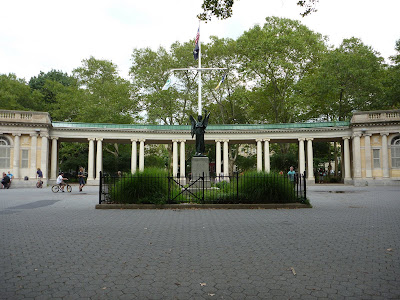


 McGorlick Park is located between Driggs and Nassau Avenues & Russell and Monitor streets in Greenpoint, Brooklyn.